
The Quiet Art of Being Remembered
How the clothes we keep — and the stories stitched into them — shape memory, identity, and the people we become
We don't often stop to examine why certain garments acquire this kind of gravity while others get donated without a second thought. The difference is rarely quality of fabric or brand name. It has almost everything to do with meaning — with whether the object has been charged, through use or through intentional design, with a story that belongs to a specific person, a specific moment, a relationship that can't be replaced.
This is a longer exploration than a gift guide. It's about the deeper question of why we keep what we keep, what the science of memory says about objects and identity, and how custom embroidery — at its best — doesn't just personalize clothing. It transforms it into something closer to a record, a monument, a wearable archive of the people and moments we can't afford to forget.
01 — Objects remember what we forget
We use calendars to remember appointments we'd otherwise forget. We take photographs to hold onto moments our brains will blur and distort. And we keep objects — specific, charged objects — as anchors for emotional states and relationships that exist only partially in language.
Clothing occupies a particularly powerful place in this system. Unlike a photograph, it has mass and texture. Unlike a diary, you can wear it. It moves through the world with you, accumulating context — the smell of a place, the particular way a collar softens with repeated washing, the small stain that tells a story only you remember.

Objects that hold memory: the clothes we keep long after they stop fitting.
"The things we own are not passive. They are active participants in the construction of identity — mirrors that reflect not just who we are, but who we have been, and who we aspire to become."
— Mihaly Csikszentmihalyi & Eugene Rochberg-HaltonCsikszentmihalyi and Rochberg-Halton's landmark study interviewed hundreds of Americans about the objects in their homes that mattered most to them. The findings were striking: the most cherished possessions were almost never the most expensive. They were the ones with the densest biographical associations — the objects that functioned, in the researchers' phrase, as "signs of the self."
Clothing appeared with remarkable frequency in their data. And the clothing that appeared most was not generic clothing. It was clothing that had been received as a gift, worn during a significant event, or — crucially — marked with something that distinguished it as belonging to a particular person, a particular story.
02 — Clothing as identity architecture
If a coat labeled "doctor" can shift cognitive performance, what does a garment labeled — through embroidery, through personalization — "this is you, this is yours, this was made for the specific person that you are" do to the wearer's psychological state?
Concept 01
Symbolic Self-Completion
Psychologist Robert Wicklund found that people use objects to signal — to themselves and others — the identities they are in the process of constructing. Personalized clothing functions as this kind of self-completion signal: a visible, wearable claim about who one is and what one values.
Concept 02
The Extended Self
Consumer researcher Russell Belk's foundational 1988 paper argued that possessions become extensions of the self — particularly possessions that we have personalized, customized, or received from someone who knew us deeply. The garment and the person become, psychologically, partially fused.
Concept 03
Biographical Objects
Sociologist Mike Featherstone described "biographical objects" as possessions whose value is inseparable from the life narrative of their owner. Unlike commodity objects, they cannot be adequately replaced by a new purchase. Their value compounds over time rather than depreciating.
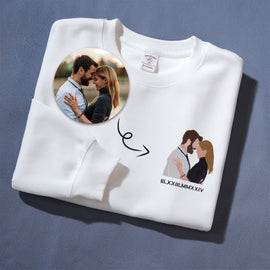
A hoodie with your dog's face on it isn't just a cute product. If it's well-made, if the portrait is accurate and expressive, if it was given to you by someone who understood exactly what that animal means to you — it becomes, over time, a biographical object. It acquires the gravity that prevents it from ever being given away.
03 — The stitch and the synapse: why texture triggers memory
Of all the personalization methods available — printing, engraving, laser cutting, embossing — embroidery is uniquely positioned to leverage the sensory dimensions of memory retrieval.
Memory research consistently shows that recall is strongest when retrieval cues match the sensory context of encoding. Smell is the most documented of these channels — Marcel Proust was documenting the phenomenon more than a century before neuroscientists confirmed the direct anatomical link between the olfactory bulb and the hippocampus. But touch follows close behind. Haptic memory — memory encoded through tactile experience — is processed through overlapping neural circuits, meaning that the physical sensation of touching an object can activate associated emotional memories in ways that visual cues alone cannot.

Each stitch is a tactile anchor — a texture the fingertips remember long after the eyes have looked away.
Embroidery, with its raised texture, its variable thread weight, its haptic distinctiveness from the fabric beneath it, is exceptionally well-positioned to exploit this. Every time a finger traces the edge of an embroidered portrait — a reflex that owners of such garments report performing almost unconsciously — the tactile input resonates through the same neural architecture that stores the associated emotional memory. The stitch and the memory become linked through repetition.
"The hands know things the mind has forgotten."
— Paraphrase of embodied cognition research by philosopher Mark JohnsonThis is also, in part, why handmade objects — or objects perceived as handmade — consistently outperform mass-produced equivalents in emotional valuation studies. The "labor theory of love," as behavioral economists Mochon, Norton, and Ariely have called it, holds that effort invested in an object increases its perceived value not just for the maker but for recipients who are aware of the labor involved. Thread-by-thread construction, even when performed by a machine guided by a digitized design, carries with it the trace of craft — the visible evidence of a process that took time, skill, and attention.
04 — The disposable wardrobe problem
Against this backdrop, the dominant model of contemporary fashion production looks increasingly strange. Fast fashion — the industrial system that has come to define how most people in wealthy countries acquire clothing — is explicitly optimized for disposal. Items are designed to feel fresh for a season and obsolete thereafter. The psychological consequence of owning a wardrobe composed primarily of such items is, arguably, a kind of attenuated relationship with clothing itself: objects that pass through the self without ever becoming part of it.
The countercultural instinct — buying less, buying better, choosing objects that will last physically and emotionally — has been growing in force for a decade, accelerated by environmental awareness and a broader cultural fatigue with the treadmill of trend cycles. But "buying better" requires knowing what "better" actually means in practice. Higher thread count is measurable. Emotional durability is harder to specify.
The slow wardrobe question: Before acquiring any garment, some minimalist and slow-fashion advocates ask: "Will I still want this in ten years?" It's a useful filter — but it points to a more interesting question. What would need to be true about this object for the answer to reliably be yes? The answer, almost universally, has less to do with the garment's aesthetics and more to do with whether it carries, or will accumulate, meaningful association.
Custom embroidery offers a specific, actionable answer to that question. A garment with an embroidered portrait of a loved one — human, animal, or otherwise — is, almost by construction, something you will still want in ten years. Not because the design is timeless in the aesthetic sense. Because the memory it encodes compounds in value over time. Because the original reason you wanted it only deepens.
05 — Why embroidery is the answer fast fashion can't give
It's worth being precise about what makes custom embroidery categorically different from other forms of personalization — and from generic clothing regardless of quality.
| Property | Generic clothing | Heat-transfer print | Laser engraving | Custom embroidery |
|---|---|---|---|---|
| Biographical specificity | ✗ None | ◐ Limited | ◐ Moderate | ✓ High |
| Tactile memory encoding | ✗ None | ✗ Flat / peels | ◐ Slight texture | ✓ Raised, durable |
| Longevity without degradation | ◐ Depends on garment | ✗ Fades / cracks | ✓ Permanent | ✓ Permanent |
| Perceived labor / craft value | ✗ None | ✗ Minimal | ◐ Moderate | ✓ High |
| Emotional irreplaceability | ✗ None | ◐ Low–moderate | ◐ Moderate | ✓ High |
| Becomes a biographical object | ✗ Rarely | ✗ Rarely | ◐ Sometimes | ✓ Consistently |
The comparison isn't flattering to the alternatives, but it's worth acknowledging what it glosses over. Not all embroidery is equal. The quality of the digitization process — how accurately a human face or an animal's expression is translated into a stitch map — determines whether the result reads as a genuine portrait or a garbled approximation. The weight and quality of the base garment determines whether the object will physically last long enough to become a biographical object. And the relationship between the designer and the customer determines whether the subtle, crucial details of likeness are preserved or averaged away.

Not all personalization is equal. Embroidery is the only method that ages with the garment rather than ahead of it.
This is why the process matters as much as the product. A custom embroidery order that begins with a design proof — a digitized preview shared with the customer before a single stitch is made — is offering something structurally different from one that goes straight to production. The proof stage is where likeness is verified, where thread colors are adjusted, where the customer's eye for their own loved one's expression is incorporated into the final design. It's the difference between personalization as a marketing term and personalization as a genuine craft practice.
06 — How to make something truly worth keeping
If the goal is to produce a garment that earns genuine biographical object status — something that will be folded carefully instead of donated, handled with something approaching tenderness — the following principles apply with near-universal reliability.
Start with the right photograph
The source image is the foundation of everything. For human or animal portraits, the ideal photo is taken at natural eye level, in good natural light, with the subject's expression clearly visible. Avoid flash photography, which flattens features and creates unnatural shadows. Candid shots — your dog caught mid-play, a child laughing in a park — almost always yield more characterful embroidery than posed portraits, because expression is where likeness actually lives. The embroidery artist can capture a quirked ear or a particular smile in a way that transcends mere physical accuracy.
Choose a base garment worthy of the design
The garment is the canvas. A 320g heavyweight fleece hoodie will carry an embroidered portrait with a dignity that a thin, pilling mid-layer cannot. This isn't about brand snobbery — it's about the physics of embroidery: thread anchored in substantial, stable fabric stays crisp through years of washing. Thread in thin, unstable fabric shifts, puckers, and distorts. The garment also needs to be something the recipient will actually wear, in a color and silhouette that suits their life — because wear is what converts a gift into a memory.
Engage with the design proof
The proof stage is not a formality. It is the highest-leverage moment in the process: the point at which you can look at a digitized rendering of your design and say, with the authority of someone who knows the subject intimately, whether the likeness is right. No designer — however skilled — knows your dog's particular expression of patient hope or your grandmother's characteristic slight smile as well as you do. The proof is your opportunity to translate that knowledge into the final piece.

The design proof is where expertise meets intimacy — the moment a customer's knowledge of the subject shapes the final result.
Order with intention, not urgency
Objects meant to last deserve to be made without being rushed. Custom embroidery is a made-to-order process: the design is digitized, proofed, and then stitched on professional embroidery equipment before undergoing quality inspection. That sequence takes time. Planning 2–3 weeks ahead of a gifting occasion isn't just practical advice — it's a posture. It says: this matters enough to prepare for properly. And that posture, oddly, tends to show in the final result.
Select your garment & size
Choose a base that will actually be worn — preferred color, the right fit, a weight appropriate for the recipient's climate and lifestyle. A hoodie someone wears becomes a memory; a hoodie in the wrong color sits in a drawer.
Upload your best photo
The design team will assess the image for embroidery suitability. High-contrast, sharp images with clear subject definition translate best. If in doubt, submit two or three candidates and ask which will yield the closest likeness.
Review and refine the proof
Take the proof seriously. Look at the eyes first — that is where likeness lives in embroidery, as in life. Check thread colors against the original photo. Request adjustments freely. This step is included in the price for a reason.
Approve & let it be made
Once approved, professional embroidery machines execute the design with a precision and consistency that hand-embroidery rarely achieves at scale — while retaining the texture and labor-evidence that makes embroidery emotionally distinct.
Receive, inspect, and give well
Quality inspection precedes every shipment. When the piece arrives, examine the stitching in good light. And when you give it — give it with the story. Tell them whose expression you spent three rounds of revision perfecting. That context is part of the gift.
07 — On leaving something behind
There is a practice in Japanese textile culture called boro — the art of patching and repairing fabric, generation after generation, until a garment becomes a layered record of all the hands that have mended it. A boro piece might be a hundred years old; the patches themselves might be sewn from the remnants of other garments, other people, other households. It is textile as genealogy. The object doesn't just survive — it accumulates.
Embroidery has always carried something of this logic. Medieval heraldic embroidery encoded family histories in thread. Japanese sashiko stitching turned peasant garments into documents of regional identity. In West African kente weaving, specific patterns communicated clan affiliations, values, and rank in a visual language readable by anyone who knew the code. Embroidery, in culture after culture, has been the method by which cloth becomes communication — by which a garment becomes a text.
"We who make embroidery know that every stitch is a decision — about color, about direction, about how much pressure the thread should carry. Those decisions accumulate. They become a record of attention."
— From a conversation with a master embroidery digitizer, China, 2024Custom embroidery in 2026 operates at an interesting intersection: the source material is a digital photograph, the design process involves specialist software, and the production uses computer-controlled machinery. And yet the output retains the essential qualities that have made embroidery a vehicle for meaning across centuries — the texture, the permanence, the unmistakable sense that something was deliberately, carefully made.
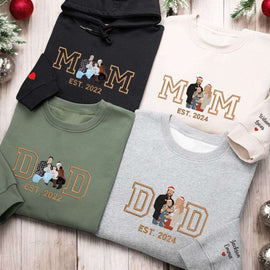
When you commission a portrait of your dog on a hoodie, or a matching set for you and your child, or an embroidered image of a place that mattered to you and a person you love, you are participating in a tradition of encoding meaning into cloth that is as old as the desire to hold onto things. You are making something that, if it finds the right person and the right moment, will be kept for longer than you can predict. It will be handled carefully. It will carry a story that is told and retold.
That outcome isn't guaranteed by the price you paid. It's earned by the specificity of what you put into it — the photograph you chose, the attention you brought to the proof, the garment substantial enough to last. Do those things well, and you haven't just bought a hoodie. You've made a small monument to someone specific. You've given them something that will remember them back.
✦ Start creating
Make something worth keeping
Upload a photo, choose your garment, and our design team will handle the digitizing, proofing, and stitching. Free shipping on orders over $69. Design proof included.